Monday, August 24, 2015

Neckbeard News

Light-hearted humor.

http://www.neckbeard-news.com/

Thursday, August 20, 2015

Spirit beings--spirit words

I am currently reading Jennifer Leclaire's Satan's Deadly Trio.  She is one of the more articulate charismatics.  I don't always agree with her outlook, but most of her stuff is quite good and worth reading.

Admittedly, the book isn't that theologically profound--and she isn't a trained theologian.  Still, I found myself saying, "Hmmm....that just might explain some things."  For example,

Since we are spirit beings created in the image of God, our words are not just sound vibrations--our words are spirit (John 6:63).

Tuesday, August 18, 2015

Notes on the Faerie Queene, Book 2

Here is the allegory of Temperance. It follows the standard medieval warrior pilgrimage. Sumpter has done a fine job of modernizing the spelling while retaining the exalted style. However, there are a few flaws with Sumpter's approach (I am not criticizing his work. It is literally one of a kind and preciously needed). Sumpter ignores (or doesn't notice) Spenser's Neo-Platonism. Without understanding Spenser's commitment to Neo-Platonism, parts of the story are incoherent. Here are some themes that will guide the reader.


Neo-Platonic Themes

Reason masters passions: “Yet with strong reason mastered passions frail” (VI.40). But this isn’t standard Neo-Platonism of the monkish sort. Passions aren’t bad. They just need to be guided by reason.

*Mediating Spirits. Neo-Platonism of its various forms sees a chain of being connecting all of reality. The material is suspended by the spiritual. Transcendence, therefore, can be found in the lowest link of the chain. Along this chain are mediating spirits (powers, angels, fairies).

*Because of his Neo-Platonism, Spenser sees a greater role for angels than we do today (VIII:1-2). Angels actively engage and empower man and thwart the enemy.

*It seems that Spenser identifies “Temperance” as a “god” (IX.1). Granted, he isn’t using god in the crude polytheistic sense. Rather, temperance seems to be a “power” or even “Archetype.” True, this could be merely poetic license, but given Spenser’s Neo-Platonism, it fits neatly.

*In the Bower of Bliss the heroes (Guyon and Palmer) come across a “false Genius.” If we accept that these characters (Genius et al) are Archetypes, we can then add the standard (neo)Platonic insight that the Archetypes and Forms have causal power. But we have a problem. The “Genius” here is a false Genius, as Spenser clearly argues (XII.47). So clearly this Genius isn’t the real genius, but a shadow one.

EXCURSUS: ALMA'S CASTLE

Alma's Castle in Book X illustrates how thoroughly committed to Neo-Platonism (and how familiar with the occult) Spenser was.  Sumpter isn't aware of these connections.

Sumpter misses the implication that Memory has hermetic overtones (Yates 2014).  Memory mediates a society’s passing down of Absolute Spirit (Magee 87).
Speculative Philosophy holds up a mirror (speculum) to the Idea itself: it allows the Idea to comprehend itself (88).  In fact, following the Kabbalist tradition, the “mirror” allows one to behold the deeper essence of Spirit (120).

This brings us back to the Hermetic Art of Memory.  “Imagination” is to evoke from memory the Perennial Philosophy.  In other words, to echo Jung, it draws out from within the unconscious.

This is rather speculative.  Is this what Spenser really had in mind? I think so.  Dame Frances Yates argues that Spenser “inherited much more than Neo-Platonism” (Yates 2001, 112). Spenser describes the man (representing memory) as “of infinite remembrance” (IX.52). Man is finite, not infinite--unless man himself was drawing upon a universal subsconcious.  I suggest this is what Spenser had in mind.  (Interestingly, Yates comments specifically on this very Canto; 114).

Yates further argues that the structure Spenser gives suggests that Man is a Microcosm of the universe.   In Canto 22 we read of a “circle” and a “triangle” with a “quadrate” (cube) in between.  The four-sided cube represents the four elements of the world, which is proportioned equally by “seven and nine.”  Seven is the number of the planets and nine is the angelic hierarchy.  If the cube is between seven and nine, then it is an eight, or an octave.  This could also represent the Temple of Solomon.


Conclusion:

Spenser’s work is literally the standard by which all other poetry is compared. Even though (or perhaps because of!) he is a Neo-Platonist, Spenser floods the senses (and the soul) with beauty and creates in the reader a desire not only for the good, but for the Beautiful, for the Heroic--indeed, for the Temperate.

This isn’t accidental. If what we have said about Forms/Archetypes’ having causal power, then then we can expect “pullings” upon our soul when reading Spenser.
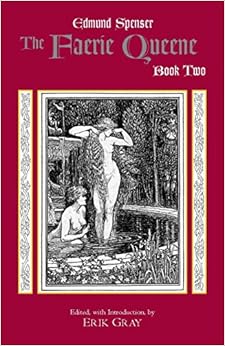

Spenser’s most memorable creation is the Bower of Bliss (as Lewis said, no prude can read Spenser). Guyon’s actions represent a neat twist in Neo-Platonism. The most temperate action is to go into a frenzy and destroy the Bower. This isn’t what we expect from a Neo-Platonist. Spenser doesn’t negate the passions--he calls them into Reasons’s service, but all the while they remain very, very passional. Spenser may have just squared the circle: he may have just redeemed Neo-Platonism.  Guyon isn't an Anchorite who tries to transcend the realm of passions.

What about Sumpter’s annotations? They are a mixed bag. When Sumpter is explaining ethics, theology, or literary symbolism, his annotations are amazing. When he tries to be funny they are worse than awful. Remember the Ron Swanson style of humor? If you have to try hard to be funny, you aren’t. Hilarity should flow from your very being. You shouldn’t have to strain to be funny. I say that because some of the wannabe funny footnotes seriously distract from the story.
Saturday, August 15, 2015

Christian Reconstruction and Radical Orthodoxy: The Difference

A common Reconstructionist refrain is "All of life is worship," usually coupled with "No square inch."  Is all of life worship?  We'll get back to that.  The underlying theme is "no neutrality" between Christian thought and non-Christian thought.  I suppose there is some truth to that.

Radical Orthodoxy will also defy a "secular reason."  They point out--with some persuasiveness--that the secular mythos is just that--a myth, a story--that is used to buttress power.  Is this another way to say that "All of life is worship?"  I think it is.

So then:  are Radical Orthodoxy and Christian Reconstructionism saying the same thing?  Even worse, has Christian Reconstructionism suddenly become intellectually respectable and morally coherent?  Fortunately, we can answer "no" to both claims.

It is true that both groups deny a secular reason and posit the centrality of the Christian story as the only true one.  However, when Christian Reconstructionists say "all of life is worship," this is implicitly done in such a way to minimize the role of the church.  Imagine a social space in which discourse inhabits.  In this social space--on the CR claim--the church has been relegated to the margin.  Why should the church be central, since all of life is holy?  Since nature supposedly abhors a vacuum, another group will arise to mediate the Christian discourse.  That's right.  You guessed it:  The Reconstructionist Parachurch Ministry (think Chalcedon or American Vision).

This is clearly not what Radical Orthodoxy is claiming.  Radical Orthodoxy, it is true, does posit a social space in which the Christian mythos is the only one.  However, Radical Orthodoxy makes one more move:

P1: The Church is social space.
P2: Therefore, instead of "all of life is worship" we have "all of life is the Church."

I think there are some problems with the RO claim, but it is certainly a healthier claim.

Wednesday, August 12, 2015

Redeeming the Dialectic by means of the Filioque

"I am trying to suggest how Christian Trinitarian logic has a mediating structure which is not dialectical. The key point here (simply to state things baldly for the present, without argument) is that that which lies “between” two poles is paradoxically “extra” to those two poles, an irreducibly hypostatic third. In the case of the infinite Trinity, this extra is itself indeed the procession of the love that lies between Father and Son (as Augustine put it)—yet the arriving externality of this thirdness is still guaranteed by the fact that Father and Son (according to the logic of substantive relation, perfected by Aquinas after Augustine) are in their mutually constitutive relationship only through this additional constitutive relationship to the Holy Spirit—which is not so much their “child” as the very womb of desire of truth in which the Father has originally conceived the Word of reason. If, to speak by geometrical analogy, Father and Son are points only because they are the two ends of one line, then this line is a line only because it is the base of a square whose remaining space is the Holy Spirit."
- John Milbank, The Double Glory, or Paradox Versus Dialectics, in The Monstrosity of Christ, p. 147

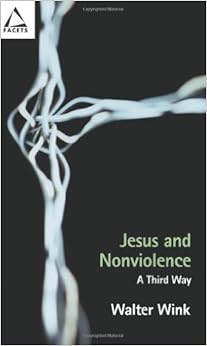
Jesus and Nonviolence

It struck me while reading this that "nonviolence" is not the same thing as Pacifism.  The latter includes the former, certainly, but the latter has political connotations that the former does not.

Wink suggests that "nonviolence" is a third way beyond Institutional Violence and Pacifism.  The former, argues Wink, represents the "principalities and powers" while Pacifism simply accepts the status quo, thus further strengthening the powers.   I think Wink's analysis of the situation is a bit simplistic, but he offers some unique insights on application.


Wink rebuts crass readings of Jesus and Romans 13 that urge passivity.  In its context, true nonviolence "provides a way to take on the system in a way that unmasks its essential cruelty and burlesque its pretensions to justice, law, and order" (Wink 21).  In other words, we are to deprive the oppressor of a situation where force is effective.

In short, Wink argues, quoting Ghandi, nonviolent revolution is a "program transforming relationships, ending in a peaceful transfer of power" (71).

So what do we make of it?  In today's Big Brother state whose methods of warfare are simply beyond what we can fathom, any attempt at "armed rebellion" is essentially suicide.  Jesus knew that.  The apostles knew that.  Practically speaking, it is.  These principles of nonviolence allow for a way to deconstruct social situations that affirm the humanity of the Other, thus ending at and aiming for an ontology of peace.

This sounds good on paper, as Wink is well aware of.  Most of the examples of nonviolence, while successful, were quite nervy.  Most people probably aren't up for that.

This book is a marked improvement on Wink's earlier treatments, though with some shortcomings. To be sure, Wink acknowledges that Communists and Marxists have done terrible evils (he was noticeably silent in Unmasking the Powers on this point).  On the other hand, Wink continually rails against "The Powers and Principalities," but we are never quite sure "who" these entities are.   I realize he covered that in his earlier volume, but he could have spent two more pages explaining it here.

All in all, an enjoyable read.

Friday, August 7, 2015

Angels mediate revelation

This isn't intended to sum up the biblical position on angels or the bible, but it is interesting.  Hebrews 2:2 writes,

For if the word spoken through angels proved steadfast...

Jewish tradition suggests that even though the Bible came from God, it came from God through angels.    St Stephen notes in Acts 7:53,

You who received the law as ordained by angels...

Galatians 3:19 continues the same thought, albeit with one modification.  St Paul writes,

[The Law] having been ordained by angels by the agency of a mediator...

So it appears that Jesus [as Word] is the mediator, to be sure, but he sends his law to angels who send it to us.  It looks like there are multiple mediations.

Why is this important?  Conservative Evangelicalism (and the entirety of TR Reformed theology) overreacted to American inanity on angels.  In my discussion at PB on near-death-experiences, even though I was basically quoting Augustine, people were "worried about the direction" I was taking.  I was worried that they hadn't gotten their angelology from the Bible.