Showing posts with label resistance. Show all posts

Sunday, June 21, 2015

Book Review: No King but Christ

The best way to describe Donald Cargill’s life is “Richard Cameron minus the muskets.”  He stood for the same principles as Cameron but ultimately did not actively confront the government.  Cargill’s life is not that different from other Covenanter field preachers, but he is set apart in that he excommunicated the king and thought out a coherent (if too cautious) theory of resistance.
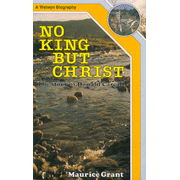
No King But Christ, The Story of Donald Cargill  -<br />
        By: Maurice Grant</p>
<p>
Like Cameron and other field preachers, Cargill rejected compromises like the Indulgence (an interesting study would be to compare the Indulgences of the post-1660 Indulgences to today’s 501(c)(3) exemptions; warning: you will lose your job as an academician if you do so). They saw this as a concession of Christ’s royal prerogatives, not only to the state, but to a debauched and degenerate monarch.  Who ruled the Church?  Jesus or the State?   It is important to point out that both sides saw their claims as absolute (shades of Rushdoony!).  If the Erastian position is true, then any resistance to his ecclesiastical claims is in fact a resistance to his civil claims.   A conservative theorist can no longer simply say, “We will resist you in the ecclesiastical realm by spiritual weapons, but we won’t resist in the civil realm.”  The Erastian (quite consistently) sees no such distinction.

Resistance

If such was the opposition between church and state, then it is hard to avoid the outcome.  This is where I think Cargill was inconsistent.  He saw the issues as clearly as Cameron did (or even more clearly), but he refused to follow the applications like Cameron did.   At his trial, his Erastian accusers asserted that Cargill’s Melvillian 2-Kingdom view led to civil disobedience (and granting their premises, they were correct):  since the Crown was metaphysically one (cf. Kantorowicz, The King’s Two Bodies), any rejection of one aspect of its sovereignty, as Head of the Church, is in fact a rejection of the Crown entire.   As Grant notes, it is civil, not ecclesiastical disobedience.

Second issue:  Charles II had sworn to abide by the sanctions of the Solemn League & Covenant–he based his legitimacy on them (which covenants, the Word of God calls binding, Galatians 3:15).  He broke the covenants; therefore, he forfeited his legitimacy over Presbyterian Scotland.  It was on these grounds that Cameron took up arms (and on other legitimate grounds; lawful self-defense and defense of the helpless, which natural law says we can do [it’s so fun to appeal to natural law when it comes to resistance; critics of theonomy don’t know what to do with that! LOL]).  And since Charles’ troops were raping and murdering their way across Presbyterian Scotland, Cameron’s struggle was a limited, defensive war which had already been justified by Samuel Rutherford.

Cargill refused to follow Cameron on these principles, but I think Cameron was right.  Given the Crown’s metaphysical assumptions, it made no sense to plead for a partial resistance.  Given that the oaths that Charles II swore to implicitly called for his removal if he broke them, resistance was justified since the law implied that.

Notwithstanding, Cargill died well.  The book is well-written and the endnotes provide a gold mine of interesting information.   Interestingly, in this book Grant is quite critical of Cameron’s actions, but in Grant’s biography of Cameron written over a decade later, he tries to justify Cameron’s actions.

Sunday, June 7, 2015

Book Review: The Lion of the Covenant

Even in the best of times the relationship between Church and State has always been uneasy. While the idea of a Christian state is lauded and is ultimately what we must struggle for, the fact remains that the State has more often than not been the enemy of the church. Even more diabolical, however, is when the ecclesiastical establishment allies with the State and it, too, becomes an enemy to the people of God. So it was in Richard Cameron’s day.

Maurice Grant does a fine job in quickly and deftly explaining the context of the Cromwellian period and afterward. Of particular note is the controversy between the Protestors and Resolutioners, the former rejecting any compromise of Jesus’ crown rights over his church. The flow of the story parallels Richard Cameron’s own life. It starts small and remains uneventful for quite some time. Grant treats his readers to the intricate details of Cameron’s own development, his turbulent ministry, and his climactic (and prophetic) death.

More importantly, however, are the issues around which Cameron fought. If the civil magistrate proclaims himself head of the church, and thus blurs the distinction between Church and State, is it logically possible to resist him only in the realm of the church but leave him be in the realm of the State. Cameron’s critics and moderate Presbyterians today say yes. Cameron said no. The Stuart monarchs also said no. One is reminded of Jesus’s statement that the children of this world are wiser than the children of light.

Cameron represents something of an embarrassment for the modern Reformed establishment. On one hand, he was a Covenanting martyr. Further, he fully identified himself with the best of the Scottish Reformation. Therefore, if you disagree with Cameron you disagree with the essence of what it means to be Presbyterian. On the other hand, unfortunately for modern Reformed seminaries, Cameron advocated a theocratic republic based on Moses’ judicials.

Even worse for the bourgeoisie Reformed, Cameron’s very martyrdom is complicated by the fact that he had pistol and sword in hand when martyred! (Of course, this doesn’t bother me at all. I think it is awesome).  Even more embarrassing, Richard Cameron correctly prophecied many times: he prophecied the deaths of several specific sinners and he prophecied that a Stuart king would never again be crowned in Scotland; making the previous even more interesting, James II, while crowned in England, lost his crown before he came to Scotland!   Or maybe it was Cargill who prophecied that.  My point is the same). 

So what should we do?

I am not uncritical of Cameron, though. I agree with his taking arms against thugs who happened to have been deputized by a foreign power. That is Lex, Rex plain and simple. Grant is correct, though, that Cameron had not thought out the issues as thoroughly as his friend Donald Cargill had. The Scottish Reformation championed the idea of armed resistance to a king. But it still saw the king as king. Disowning a king, however, runs very close to the Romanist concept of a pope deposing kings as he saw fit. Cameron could have justified his actions with far more powerful arguments by relying much more closely on Rutherford.

Should we, likewise, resist tyrannical rulers? Well, it depends. Our situation is not analagous to Cameron’s, though one suspects the we live in a secular Erastianism. Cameron was fully justified in resistance because by culture, tradition, and prior law he was bound to uphold the Covenants.