Showing posts with label anchoritism. Show all posts

Tuesday, August 18, 2015

Notes on the Faerie Queene, Book 2

Here is the allegory of Temperance. It follows the standard medieval warrior pilgrimage. Sumpter has done a fine job of modernizing the spelling while retaining the exalted style. However, there are a few flaws with Sumpter's approach (I am not criticizing his work. It is literally one of a kind and preciously needed). Sumpter ignores (or doesn't notice) Spenser's Neo-Platonism. Without understanding Spenser's commitment to Neo-Platonism, parts of the story are incoherent. Here are some themes that will guide the reader.


Neo-Platonic Themes

Reason masters passions: “Yet with strong reason mastered passions frail” (VI.40). But this isn’t standard Neo-Platonism of the monkish sort. Passions aren’t bad. They just need to be guided by reason.

*Mediating Spirits. Neo-Platonism of its various forms sees a chain of being connecting all of reality. The material is suspended by the spiritual. Transcendence, therefore, can be found in the lowest link of the chain. Along this chain are mediating spirits (powers, angels, fairies).

*Because of his Neo-Platonism, Spenser sees a greater role for angels than we do today (VIII:1-2). Angels actively engage and empower man and thwart the enemy.

*It seems that Spenser identifies “Temperance” as a “god” (IX.1). Granted, he isn’t using god in the crude polytheistic sense. Rather, temperance seems to be a “power” or even “Archetype.” True, this could be merely poetic license, but given Spenser’s Neo-Platonism, it fits neatly.

*In the Bower of Bliss the heroes (Guyon and Palmer) come across a “false Genius.” If we accept that these characters (Genius et al) are Archetypes, we can then add the standard (neo)Platonic insight that the Archetypes and Forms have causal power. But we have a problem. The “Genius” here is a false Genius, as Spenser clearly argues (XII.47). So clearly this Genius isn’t the real genius, but a shadow one.

EXCURSUS: ALMA'S CASTLE

Alma's Castle in Book X illustrates how thoroughly committed to Neo-Platonism (and how familiar with the occult) Spenser was.  Sumpter isn't aware of these connections.

Sumpter misses the implication that Memory has hermetic overtones (Yates 2014).  Memory mediates a society’s passing down of Absolute Spirit (Magee 87).
Speculative Philosophy holds up a mirror (speculum) to the Idea itself: it allows the Idea to comprehend itself (88).  In fact, following the Kabbalist tradition, the “mirror” allows one to behold the deeper essence of Spirit (120).

This brings us back to the Hermetic Art of Memory.  “Imagination” is to evoke from memory the Perennial Philosophy.  In other words, to echo Jung, it draws out from within the unconscious.

This is rather speculative.  Is this what Spenser really had in mind? I think so.  Dame Frances Yates argues that Spenser “inherited much more than Neo-Platonism” (Yates 2001, 112). Spenser describes the man (representing memory) as “of infinite remembrance” (IX.52). Man is finite, not infinite--unless man himself was drawing upon a universal subsconcious.  I suggest this is what Spenser had in mind.  (Interestingly, Yates comments specifically on this very Canto; 114).

Yates further argues that the structure Spenser gives suggests that Man is a Microcosm of the universe.   In Canto 22 we read of a “circle” and a “triangle” with a “quadrate” (cube) in between.  The four-sided cube represents the four elements of the world, which is proportioned equally by “seven and nine.”  Seven is the number of the planets and nine is the angelic hierarchy.  If the cube is between seven and nine, then it is an eight, or an octave.  This could also represent the Temple of Solomon.


Conclusion:

Spenser’s work is literally the standard by which all other poetry is compared. Even though (or perhaps because of!) he is a Neo-Platonist, Spenser floods the senses (and the soul) with beauty and creates in the reader a desire not only for the good, but for the Beautiful, for the Heroic--indeed, for the Temperate.

This isn’t accidental. If what we have said about Forms/Archetypes’ having causal power, then then we can expect “pullings” upon our soul when reading Spenser.
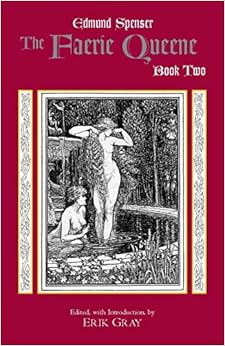

Spenser’s most memorable creation is the Bower of Bliss (as Lewis said, no prude can read Spenser). Guyon’s actions represent a neat twist in Neo-Platonism. The most temperate action is to go into a frenzy and destroy the Bower. This isn’t what we expect from a Neo-Platonist. Spenser doesn’t negate the passions--he calls them into Reasons’s service, but all the while they remain very, very passional. Spenser may have just squared the circle: he may have just redeemed Neo-Platonism.  Guyon isn't an Anchorite who tries to transcend the realm of passions.

What about Sumpter’s annotations? They are a mixed bag. When Sumpter is explaining ethics, theology, or literary symbolism, his annotations are amazing. When he tries to be funny they are worse than awful. Remember the Ron Swanson style of humor? If you have to try hard to be funny, you aren’t. Hilarity should flow from your very being. You shouldn’t have to strain to be funny. I say that because some of the wannabe funny footnotes seriously distract from the story.

Sunday, June 28, 2015

Book Review: Imagining the Kingdom

We all know that worldviews (hereafter w-v) are inescapable. Worldviews rarely move beyond the intellectual dimension.  Smith doesn’t want to do away with w-v talk, but to place it within a larger whole.  We are not simply isolated intellects, but situated intellects--situated and embodied.  We are always embodied individuals and we experience the world as being-in-the-world (per Heidegger).

And we are not Gnostics.  Rather, “The Spirit marshals our embodiment in order to rehabituate us into the kingdom of God (15).”


What is imagination?  Smith defines imagination as  “a kind of faculty by which we navigate and make sense of our world, but in ways and on a register that flies below the radar of conscious reflection” (19).  This is why using concepts like “social imaginary” or “plausibility structure” is much superior to w-v.   W-v rightly highlights the inescapability of presuppositions on our thinking.  We do not deny that.  Smith notes, however, that social structures and our bodily being-in-the-world also function in a “pre-theoretical” (per Dooyeweerd) manner.

Knowing in the Body and By Stories

Liturgies are not only aesthetic, but kineasethic.  They come to us in the body and tell a story.

Perceiving by Stories

*Who we are is shaped by the stories we encounter and imbibe.  “We live into the stories we’ve absorbed; we’ve become characters in the drama that has captivated us” (32).
*narrative trains our emotions and those emotions condition our perception of the world.
*we are not disembodied choice machines.

Smith aims to capture “the creational conditions of human action” (33).  This is where Anchoretism fails.  Anchoretism seeks to transcend finitude and attain unto hyperousia.

*Perception and evaluation are intricately linked.
*“Affect and emotion are part of the ‘background’ I bring with me that constitutes the situation as a certain kind of situation” (35).
*“Stories are means of emotional prefocusing that shape our tacit ‘take’ on the world” (38).
*Antepredicative know--the affective register upon which narrative operates--is processed by the body below the cognitive level (Merleau-Ponty).

Pre-cognitive perception breaks down the traditional epistemology of subjects and objects.  "The world is not what I think, but what I live through” (Merleau-Ponty).  Our being-in-the-world is between instinct and intellect (43).  We aren’t just thinking-things.  “We don’t have being-in-the-world; we are being-in-the-world” (44).

More on Stories

A story has a “flow” and “rhythm” that simply isn’t reducible to a string of facts.  A string of facts is not a story.  It’s a memo.  No one dies for a memo.  No one’s embodied life is transformed by a data brief.  But people do die for the Story of Matthew, for instance.

“The material meaning of a poem means uniquely because it is meant on the register of motor intentionality” (Merleau-Ponty).  Kineaesthetic and Poetics are interconnected.

Worship: Story as Liturgy

Smith doesn’t add too much on Reformed liturgies.  He does apply his earlier insights into how it shapes stories, drawing on scholarship on John Calvin.  We can rejoice that more Evangelicals are moving away from “3 songs and a lecture, 3 points and a poem.”  People don’t die for that, either.  So, good stuff here.

We live at the nexus of story and body--a “between” space where the aesthetic power of a story captures our imagination because it resonates with our body. And all good liturgies tell an implicit story.  The Holy spirit reconfigures our neural maps.

Liturgy is a shorthand term for those rituals that are loaded with a Story about who and what we are (139).  It is an imaginative social practice that captures our imaginations by becoming the stories we tell ourselves in order to live.

Criticisms:

Smith admits he has a hard task: steer a middle course between popular literature and the scholar.  He kind of succeeds.  His thesis is fascinating and I believe (literally) life-transforming.  Still, one gets the feeling he is often “Dancing on the edge” rather than “diving in for the kill shot.” As a result, a lot of sections seemed to “go on” in a way that repeated earlier chapters.  

Monday, June 15, 2015

Whose Community? Which Interpretation?

By Merold Westphal

Thesis: Westphal, following James K. A. Smith's The Fall of Interpretation, argues that we should not seek a "pure stream" reading of the Bible that bypasses the act of interpretation. This position of seeking and *im*mediate reading of the text has precendents in Plato0 when he said the philosopher apprehends the purely intelligible structures (Phaedo 66e) In other words, our reading of the Bible is mediated to us by our hermeneutical filters, be they cultural, linguistic, philosophical, or whatever. 

In less abstract talk: have you ever seen the advertisement for a particular translation claiming, "No interpretation needed"? Westphal argues against such naivete. This should not alarm Reformed folks. Did Van Til not say that there are no brute facts but all facts are already pre-interpreted by God? 

Musing: Is Van Til a right-wing deconstructionist?

Westphal then examines recent moves in philosophical hermeneutics from the Romantics to Schlieirmacher to Wolterstorff.

But What About the Radical French Postmodernists?

So far Reformed readers will have no problem with the above narrative. The problem comes with the French trio (Derrida, Foucault, and someone else) who assert, so it is said, "The death of the author." 

But maybe they aren't saying exactly that (mind you, I have my own questions about Derrida). 

Even the French trio doesn’t think the author is truly dead. “To deny that the author is the unilateral source of a text’s meaning is not to deny that the author plays an important role” (58). Westphal explains, “For our French trio, the finitude of the author in relation to the text is expressed in a double relativity. In the first place, human authors ‘create meaning’ only relative to the language available to them...this language shapes and conditions their thought in ways of which they are unaware and over which they do not preside” (59). 

To say it yet another way: “The author is not a godlike, infinite creator of meaning” (65). Humans are finite and our sub-creations (what Milbank would call mythopoesis) are always within the realm of the finite and conditioned.

This is fully in line with Reformed anthropology. 

Westphal then comes to the heart of his project: Hans Georg Gadamer. We must affirm tradition, but in line with our anthropology, we must affirm the "finitude" of our tradition. 

Gadamer's fundamental thesis about tradition is “belonging.” p. 70. Tradition plays a double-role. It gives us a place to stand and it is is plural. We do not belong to a single, universal tradition. “All interpretation is relative to traditions that have formed the perspectives and presuppositions that guide it” (71).

“To be historically means that knowledge of oneself can never be complete” (Gadamer, Truth and Method, 301-302). 

Westphal then offers several theses on reading tradition and being read by tradition:

Alterity Thesis. Tradition as other. Tradition will set before us what it has already done within us.

Authority Thesis. We acknowledge tradition as a “sub-authority” over us. “My conscience is a grounded opacity that allows a richly mediated knowledge of its object” (Westphal 74). 

Fallibility Thesis. Question of critique: “How can we distinguish the true prejudices--by which we understand--from the false prejudices (by which we misunderstand” (75). Tradition must be open to this critique. Even worse, the difference between true and false is not always either/or but a matter of degree. Here is where Anchoretic traditions fail mortally.

What the French Should have said

Authorial intent is important in understanding a text, but only to a degree. Authors themselves are wirkungsgeschichtliches Bewusstein, historically effected consciousness. They don’t have absolute self-transperancy either. Westphal has an interesting suggestion: “there is a power at work in finite authorial creation--for Gadamer, tradition--of whose agency and effects the author is never fully aware” (81). 

Conclusion and Evaluation

In terms of philosophical analysis the work is first-rate. Westphal may be the only Continental-school philosophy who can write clearly. Unfortunately, Westphal moves to analysis--and since that deals with the church, theology. Here the book suffers from ambiguity or simply wrongness. 

Westphal suggests we should follow Gadamer in seeing Truth Beyond [Scientific] Method. I have no problem with that, but aside from references to beautiful art and literature, I am not exactly sure what he wants me to do.

Westphal offers an interesting paradigm for understand difference in the church. He highlights the debate between political liberalism (classical liberalism in society) and communitarianism (Alasdair MacIntyre). Political liberalism affirms difference but in the midst of an overlapping sphere of agreement among the parties involved. Of course, this is valuable for the church: we will disagree at times, and even traditions (Rome, EO) that pretend to be uniform have to own up to that. Ironically, though, it is rather strange to find a postmodern writer affirming classical liberalism, which is a child of the Enlightenment. 

Westphal realizes that and admits the communitarian model is probably better for the church (but he rejects it for the state).

The book ends with a hopeful suggestion taken from the Roman-Lutheran Joint Declaration on Justification. The theology behind such a move is atrocious and one is disappointed that Westphal ended a fine book on so weak a note.

Friday, June 5, 2015

The sola scriptura that you haven't heard

To my fellow-Protestants,

If you continue to say asinine things like "The Bible alone is the only authority" or "The Bible alone is the only source of knowledge," any Anchorite epologists will eat you alive.

To my Anchorite Friends,

You probably think that sola scriptura means "The Bible alone."  If you converted from Protestantism to Anchoritism, you likely didn't have a good grounding in historic Reformed dogmatics (you probably didn't read Muller or Bavinck's Prolegomena; you probably reduced the Reformed faith to the Five Points).  However, to be fair to you, your Protestant interlocutors are likely making the same mistake.

Sola Scriptura means the Bible is the principium cognoscendi.  It is our external cognitive foundation for theological knowledge.  It is the final authority of theological knowledge.  If it is the final authority for theological knowledge, that necessarily implies lesser sources of knowledge. This means Protestants cheerfully welcome lesser warrants of belief:  traditions, liturgy, lives of the saints (Hebrews 13:7), general revelation, and (and here is where I get in trouble), words of wisdom.

If the Bible is the only source of theological knowledge, then it can't be a judge of theological knowledge (obviously, since any other knowledge is necessarily wrong).

Someone could respond, "Yeah, but it's your interpretation of the Bible that is the final judge of knowledge, which means you think you are the final judge."  That sounds like an impressive rebuttal, but it's not.  As Bavinck pointed out, this person confuses the organ of knowing with the source and standard of knowing.

(1)  Yes, I am using my own reason and judgment.  I would be a fool not to.

Everyone, including the Anchorite, uses his reason to evaluate claims.  But I know my reason is prone to error.

(2) Since fallible, my reason is open to correction from other cognitive sources (tradition, alternative interpretations, natural revelation).

Someone could object, "But that's making everything subjective.   How is this not relativism?"  I refer to the aforementioned confusion of organ and source.

(3) Any type of reasoning which sees reason as an organ of knowing will be subjective.

(3') The organ of knowing is within the knowing subject.

Is this a vicious relativism? We see that charge but no reason to think so.

(3*) The organ of knowledge is within the knowing subject.  The source of knowledge is external to it.

Case study for Eastern Orthodox.  Vincent of Lerins said the church has always taught the imputation of Adam's guilt.  Have fun with that one.  

Tuesday, May 12, 2015

Problem of Criterion as a theological key

How do you know?  How do you know that you know?  This is the problem of criterion, and far from being a technical point in epistemology, it is huge for theology and the life of the church.  It runs like this:

How do we decide in any case whether we have knowledge in that case? What are the criteria of knowledge? (Moreland 2007, 123).

To risk a dangerous oversimplification, "How do we know that we know x?"  Here is an example.  If I tell someone that God gave me a word of knowledge, the cessationist will respond, "Yeah, but how do you know that was from God?"

If I say that I have the internal testimony of the Holy Spirit bearing witness that I am a child of God and destined for heaven, the anchorite will ask, "Yeah, but how do you know that without using your own subjective demon-inspired reason?"

It boils down to this:  Before I can legitimately claim knowledge in these areas I must first satisfy the condition of knowing how I know.  Seems fair enough and few people challenge this.

But there is a problem.  Before I can know anything (say P, representing that I have the internum spiritum sanctum), I must know two other things: Q (my criterion for knowledge, which the critic seeks) and R (the fact that P satisfies Q).  But there is no reason to stop here.  One can now ask how I know Q and R, to which the new answer is Q' and R'.  But now I have to give a reason for Q'' and R''.  Further, I must now give a reason for Q''' and R'''.

Said another way:  Before I can know, I must know how I know.  Before I can know how I know, I must know how I know how I know.  And on the nightmare goes.

Best just to dismiss the critic's question. But before that, let's give our own solution. We can start by knowing specific, clear items of knowledge.  We can solve the problem of criterion by beginning with particular cases of knowledge and generalising to formulate a criterion for true belief.  For example, while I know my faculty of reason can be faulty at times, I had to use the faculty of reason to write that sentence (assuming A = ~~A and that my terms meant what they meant).  Using this reason I am able to read texts (and everyone will assume the text is clear at at least one level, otherwise why would you ever appeal to an opponent to read a text like 2 Peter 1:4?).  This immediately falsifies the claim that I can't understand a text unless I am already in a community of text (no one seriously believes this when push comes to shove).  

Moreland, J. P. Kingdom Triangle. Grand Rapids, Zondervan, 2007.  

Wednesday, April 15, 2015

Ecumenical Ascesis: Giving and Taking Away with the same hand

My recent studies in philosophy of mind and consciousness have brought me back to the desert fathers.  I think they have some profound insights on depression and wholeness.  Of course, their understanding of salvation and the work of Christ is an utter disaster.  

The more friendly-minded Eastern Orthodox will say that “The Spirit is working in other Christian traditions,” and that is nice of them to say so.  However, they will also say that true healing of the nous (it’s hard to find an evangelical equivalent of that phrase.  Picture a midway point between justification and sanctification and call it salvation) can only happen within the life of the Church.

But if the Spirit is working outside the boundaries of the church, can it not be that true healing is happening there?  If so, then what of the other claim that healing of the nous can only happen within the liturgical and ascetical life of the church?

Further, what of the Evangelicals who have engaged in healing ministries?  I don’t mean specifically bodily healing, though that’s included, but healing of the psyche.  John Wimber comes to mind.  Unless one wants to say “he does it by demons,” one is forced to conclude that the power of Christ--never separated from his body--is operative in Evangelicalism.   Therefore, Evangelicals are part of the Body of Christ.  

Monday, March 30, 2015

Demonic warfare argument against One True Church (™)

The point:  (1) I am making a claim against those traditions that posit their communion is the One True Church.

(2) If Satan's kingdom is divided against itself, it will not stand--Jesus (or Abe Lincoln)

(3) If Protestant/Evangelical pastors are successful in evangelism and church growth, then there is the likelihood that they are leading people away from the One True Church (™).

(4) However, it is well-known that Evangelical pastors have been attacked by demons who opposed their churches (Wagner 1992).

(5) Demons do not attack their own outposts (Modus Tollens, 2).

(6) Demons, therefore, attack Christian outposts (or Kingdom outposts; I like that one better).

Therefore, one must conclude,

(7) Evangelical communions--some, anyway--are Kingdom communions and Christian churches.

Therefore, the position entailed by (1) is false, that only certain anchoretic communions are in fact One True Church (™).

The nicer adherents within those denominations will say,

(7') "We've never said the Spirit isn't working in Evangelical communions; He may be working but we are the One True Church (™)).

That is very kind of them, but it is really hard to square with (1) and (2).  To prove this we have to advance the next argument:

(8) The Spirit doesn't work counter to the Spirit.

If the Spirit is supposed to build up the Church, and the Church is defined as a specific institution of which Evangelicals are not a member, then the Spirit can't build up--and therefore lead away--those other communions.

An anchorite could respond with

(8') The Spirit can't be judged by human logic.

There is a truth to (8') but I think if applied consistently it is an epistemological acid drip.  Along with (8) we must also say,

(9) The Spirit doesn't work contrary to Christ (The Filioque really helps at this point, but I suppose it isn't necessary to the argument).

(10) If (8) and (9) hold, then we cannot really have no grounds for denying that Evangelicals are members of Christ's body, heirs of God and fellow-heirs with Jesus Christ.

Sunday, February 15, 2015

Jesus's feeding me is special enough

Peter Leithart wrote an article pointing out that high church liturgies seem "magic" and out of touch with the simplicity of what we see in the gospels.  I don't know why Anchorites got upset.  Even if you believe your tradition is the truth, and even if you believe in an ethereal "tradition" (which you admit you can't point to or verify without asserting the consequent), the gospels simply don't have an elaborate service.

I'm not here to defend Leithart.  He's done enough damage to Protestantism, but he has a point.  At the supper Jesus promises to feed me and eat with me.  Why do I need to "spruce it up" with an elaborate ontology?  Is Jesus's Word and Spirit good enough, or not?

Someone could respond, "We worship in an unbroken way for thousands of years."  Perhaps, but that's not how Jesus did the worship service at the Passover.  

Tuesday, December 23, 2014

Neo-Church Fathers, hellenism, or extra nos proclamation


To help put the below in context, here is a picture of Chain of Being


"Like the dead, take no account of either the scorn of men or their praises, and you can be saved." -St. Makarios the Great.
“Struggle until death to fulfil the commandments: purified through them, you will enter into life.”
—St Thalassios the Libyan

Response:  if all he means by this is struggle in sanctification, no problem.   

A person must first spend a long time in ascetic practice. He must begin by purifying his body from the actual committing of sin, whether great or small, and then purge his soul of every form of desire or anger. His moral impulses need to be disciplined by good habit, so that he does not do anything whatsoever through his five senses that is contrary to the purpose of his intellect, [This is very good Hellenistic philosophy, but very bad Hebraic revelation--JBA]  nor does his inner self consent to any such thing. It is then, when finally he becomes subject to himself, that God makes all things subject to him through dispassion and by the grace of the Holy Spirit. For a man must first submit to the law of God, and then he will rule as an intelligent being over all around him. His intellect will reign as it was originally created to reign, with judgment and self-restraint, with courage and justice. Now he will calm his wrath with the gentleness of his desire, now quieten his desire with the austerity of his wrath; and he will know that he is a king. All the limbs of his body, no longer abducted by ignorance and forgetfulness, will act in accordance with God’s commandment. Then through his devotion to God he will achieve spiritual insight and will begin to anticipate the snares prepared by the devil and his secret and stealthy attacks.St Peter of Damaskos

If this is true, and if this is being used as the ground of salvation, and this is the purported biblical teaching, then why did Paul worry about being accused of antinominism.  At least Roman Catholicism pretends to give grace a role.

“Forgiveness of sins is betokened by freedom from the passions; he who has not yet been granted freedom from the passions has not yet received forgiveness.”
—St Thalassios the Libyan

It's hard to imagine Paul being accused of antinominianism in Romans 6 if he were preaching the above.

The only path to salvation is the  unwavering following of the instructions of the Holy Fathers
~Ignatios Briannchaninov

Seems like Jesus got replaced.

“Chastity's wings are greater and lighter than the wings of marriage. Intercourse, while pure, is lower. Its house of refuge is modest* darkness. Confidence belongs entirely to chastity, which light enfolds.”
—St Ephrem the Syrian, Hymns on the Nativity

Notice the language of higher/lower.  Spiritual (mind) stuff is higher on the scale than passional stuff.  This is Hellenism with a vengeance and it is foreign to the Bible.  My whole outlook on life is one total negation of this mentality.  

“Since Elijah repressed the desire of his body, he could withhold the rain from the adulterers. Since he restrained his body, he could restrain the dew from the whoremongers who released and sent forth their streams. Since the hidden fire, bodily desire, did not prevail in him, the fire of the high place obeyed him, and since on earth he conquered fleshly desire, he went up to the place where holiness dwells and is at peace. Elisha, too, who killed his body, revived the dead. That which is by nature mortal gains life by chastity, which is beyond nature. He revived the boy since he refined himself like a newly wind infant. Moses, who divided and separated himself from his wife, divided the sea before the harlot. Zipporah maintained chastity, although she was the daughter of pagan priests; with a calf the daughter of Abraham went whoring.”—St Ephrem the Syrian, Hymns on the Nativity

This is funny since Elijah called down fire on men.  Was he doing it Jedi-style, with the passions neutral?  

Monday, December 22, 2014

Table as Feast, or the god of grape juice

Feast, not transformation.  Table, not altar.  

Zechariah 9:15, “The Lord of hosts will protect them,
and they shall devour, and tread down the sling stones,
and they shall drink and roar as if drunk with wine,
and be full like a bowl,
drenched like the corners of the altar.
“But the passage pictures Israel drunk with another kind of wine: filled with the wine of Yahweh’s Spirit, Israel would be bold, wild, untamed, boisterous in battle. This suggests one dimension of the symbolism of wine in the Lord’s Supper: it loosens our inhibitions so that we wil fight the Lord’s battles in a kind of drunken frenzy. If this sounds impious, how much more Psalm 78:65, where the Divine Warrior himself is described as a mighty man overcome with wine? Yahweh fights like Samson, but far more ferociously than Samson: He fights like a drunken Samson!" (Leithart, Blessed are the Hungry).

But that's not how the American Christian fights.

“Grape juice at the communion table symbolizes the historical impotence of Christ’s blood, Christ’s gospel, Christ’s church, and Christ’s expanding kingdom. Grape juice stays ‘bottled up’, confined to the historical skins of Palestine.”
~Gary North

Also bad is any attempt to deny the drinking motion of a cup in communion.