Tuesday, August 4, 2015

Rightly Ordered Loves

This is a summary of Joan Lockwood O'Donovan's essay "Christian Platonism and Non-Proprietary Community."


Thesis: The possession of rights is always proprietorship.  In the Western tradition all natural rights originate in property right.

Pope John XXII proposed that from the moment of creation all mankind was collectively endowed with full lordship in the sense of ownership over earthly goods.

Patristic Foundations of Non-Proprietary Community

Augustine distinguished between two rights on which earthly goods are based: divine right, in which all things belong to the righteous, and human right--which is in the jusridiction of the kings of the earth (Ep. 93, NPNF (1) I:400.).


Eventually, this would be seen that in a just commonwealth, "the highest and truest common good, namely, God, is loved by all, and men love each other in Him without dissimulation" (Ep. 137.5.17).  Therefore, bonum commune is above all a sharing in rightly ordered loving--an activity that is entirely common in the sense of inclusive and participatory because entirely spiritual (JO, 80).

"By contrast, Augustine conceived of the disordered love of the soul as the privatization of good, in that it entails the soul's turning away from the universal common good to its private good, that is, to itself as privately possessed."

"In the body politic, disordered love is the destruction of community, of the bonum commune, because it involves radical loss of the shared spiritual possession of being, meaning, and value."
  • regulated interaction of private spheres of degenerate freedom.
Franciscan Poverty: The Theology of Evangelical Non-Possession

In the later middle ages the distinction between common property and common non-proprietary possession never surfaced.
  • Bonaventure moved the debate forward.  By drawing upon the Christian neo-Platonic tradition, he was able to posit the Trinity/Word as font and finis of thought and spirituality. 
  • Christ's life revealed "Evangelical Perfection."
  • This meant that Bonaventure's order saw the claiming of spiritual goods for oneself and against one another.  It disrupts the human response to divine love (84).
  • Renouncing the property right means the wayfarer is not a self-possessor, but is possessed by Christ, receiving from Him all the good that he is, has, and does (85).  
Wyclif's Ecclesiological Revolution

Fitzralph (Wyclif's intellectual predecessor) argued that God's "gift of lordship to Adam is a communication or sharing of himself and his lordship rather than an alienating transfer of lordship, which would diminish God--a communicating and communicable possession and use of things according to rational necessity" (89).
  • "Wyclif's core Augustinian insight is that just lordship over earthly goods involves rightly ordered love toward them, which in turn depends on the true knowledge of them available only in Christ"
  • Evangelical dominion, therefore, is the just communal possession and use of earthly goods that shadows God's own dominion by conserving the being of non-human creatures...
Conclusion

"We are not our own but Christ's" (1 Cor. 6.19).  "As we are possessed by Christ and receive ourselves from him, the central act of our willing is one of conforming to his will" (92). 

  • When we encounter other goods, we first possess them in their essential being, through knowledge illumined by the love of Christ, before answering the demand or claim that they present" (93).
  • We are "claims," not "rights-possessors." 
  • By conforming to Christ, we respond and recognize that the Other is.  We fulfill the demands of Justice, but not the demands of one another (this solves Hegel's problem.  We introduce the Other as loved).  
Righteous human lordship is communal chiefly because it is spiritual (this is where Reconstructionism in its libertarianism is so horribly wrong).
  • Righteous "human community is a sharing in or communication of spiritual goods before physical goods."
  • "Only the fellowship of the Holy Spirit entered into through the divine-human communication of Christ crucified and resurrected makes possible an inclusive communion in the use of physical goods.  No meum or teum
  • Common possession means that no one acts as if any good belongs to him/her in any excluding or even particularizing sense (94).

Monday, August 3, 2015

My summary of Near Death Experiences

I debated this on Puritanboard.  The only good thing that came out of it is I got to sharpen my own thoughts.  I don't really see any future in Reformed apologetics.

You say you weren't impressed with my arguments, but my premises were all drawn from the Christian tradition, the negation of which would be heresy.  I'll restate it.

P1: Body and Soul are not the same thing (correspondingly, neither are brain and mind, which is why I didn't put immediate stock in "physical" explanations.  Physical explanations can only explain the brain, not the mind, otherwise the truth would lie with Dawkins).

P2: The soul outlives the body.  Otherwise, Jesus's parable about Lazarus and the Rich Man would be incoherent.

P3: The Christian tradition holds to immaterial entities that do not exist spatially. We call them angels or demons (and we have a natural revelation analogue: Plato's Forms, Jung's Archetypes)

P4: These entities primary mode of existence is outside the time-space continuum.  Otherwise Belinda Carlisle would be right and heaven would be a place on earth.

P5: (4) helps us understand the soul's mode of existence after death.  Either it doesn't exist, and we have heresy.  Or it exists on earth and we just committed ourselves to the next season of Ghost Hunters, or it exists "on the other side" (call it heaven or hell or hades).

P6: The key problem is that some think I have argued for a realm of existence between Death and Life called "near death experiences."  I have argued for no such thing.  I'm fine with mystery.  But I am not going to be like the Eastern Orthodox apologists I debate and start chanting "Mystery" whenever I come across facts that don't fit my paradigm.

P7: The best explanation--and I am not arguing this as dogma--is that in those "near-death" moments the veil is pulled back or the boundary is weakened.

P8: What about the "Happy Hindus?"  Or more precisely, say there is a dissolute person who sees the proverbial "bright light."  Does that mean the wicked see "heaven?"  Not necessarily.  One of the key points I argued for--and this is Van Til 101--is that facts and interpretation of facts are not the same thing.  The person is probably seeing new phenomena for which he or she has no previous way of evaluating and opts for the next closest analogue.

Reading Plan for August 2015

I really want to get Milbank's Beyond Secular Order, but I have to read some other stuff first (and I can't afford it at the moment).  So here goes:

Plotinus, Enneads

Kant, Critique of Pure Reason.

William Morris, Wolfings and Roots of the Mountain.

Milbank and Pickstock, Truth in Aquinas (reread).

George MacDonald, Lilith.

Dostoevsky, The Idiot (more than 3/4 finished)

Saturday, August 1, 2015

On not ossifying the fathers

I am trying to take a more positive, constructive role in theology.  This post is akin to an autobiographical manifesto.  Part of it is how I came to the church fathers and ultimately my critical-appreciation of them, and the other part is how to use the Fathers to kill souls.

I left seminary disillusioned.  While I had made a lot of intellectual mistakes there, academically it was not the best (in terms of actually doing scholarship).  I didn't want to say that the Reformed faith was wrong, despite RTS's best efforts to make it so, but I knew there was something more.

For reasons I don't entirely remember, I was reading Thomas Aquinas as I left seminary.  I had one foot in the door for medieval and patristic theology.  I am not sure how I first heard of John Milbank.  I do remember reading about him in James K. A. Smith's Introducing Radical Orthodoxy.  This was late 2006, early 2007.

There is a lot wrong with Radical Orthodoxy, but there is a lot right--and a lot that is just plain fun.  So what that they over-interpreted Aquinas as a Neo-Platonist?  They got all the right people in academia angry, and that is good.  For me they introduced me not only to a wider world of theology but also to ask different--deeper--questions of church history.

I dove right in.  And made mistakes.  But I also latched on to key points: how Christology shapes everything.  (Some Eastern Orthodox guys played that card as a front to justify going to Eastern Orthodoxy when in reality they wanted smells and bells, but that is another story).  Anyway, I realized that Systematic Theology didn't have to follow the outline of Berkhof (Berkhof is useful but limited to a certain context, namely a seminary classroom).

Before continuing on the RO line, I should probably address a common criticism:  Did RO read Reformation metaphysics correctly, namely that Western theology took a nominalist turn with Scotus and the Reformation crystallized it?  Obviously, anyone who advances that reading today will be laughed at. So we can say RO was definitely wrong on that point.  Further, not all of Milbank's criticisms in "Alternative Protestantism" hold water (or at least they might attack Reformation ontology but not where Milbank thinks they do).

This was around 2008-2009.  I was able to read the Father without pretending that the Fathers were a complete deposit who taught a unified, identifiable theology across time and space.  Moreover, I was able to honestly say, "St ______ is wrong here.  That's okay.  I can still benefit from what he says elsewhere."  Side note:  Remember that stupid facebook meme that has the Nicene Fathers pictured and the caption reads, "So these guys are right about the canon but wrong about everything else?"  The epistemological howlers in that statement are too painful to mention.

Back to the Fathers.  Since I didn't (at the time) believe the Fathers taught a unified, ahistorical body of truth, that meant I didn't have to play East and West against each other.  I could say guys like Anselm, Aquinas, and Wycliff were good guys.  And I could benefit from the modern John Wycliff, Oliver O'Donovan.  While some Ecumenist Orthodox guys will speak kindly of the aforementioned gentlemen, technically speaking they are heterodox (or heretics!), so good luck with that one.  The harder-line folks will say that they (and by extension, you and me) are deprived of grace.

Towards the end of 2010 I moved into a harder, Eastward direction.  I never officially became Orthodox.  It wasn't viable for a number of reasons.  While this meant I accepted Orthodox doctrines like anti-Filoque and icons, the main problem is I had to cut off my theological past.  Another problem is I had to place the Fathers within the received tradition of the church.  This implied a number of cognitively dissonant positions:
  • The Fathers are part of Holy Tradition but I must interpret which Fathers are speaking Orthodoxically by Holy Tradition.  I couldn't square the circle.  All of the Orthodox problems with Sola Scriptura would come crashing down on Tradition.
  • This meant that the Fathers probably didn't disagree about "big stuff."  
  • So what was I supposed to do when I came to issues where the Fathers sounded "Western" or were plain wrong?  
The dissonance was building up.  Move on to the end of 2011. I was beginning to be more "Western" in terms of cultural outlook.  I just didn't feel right "negating" my Western heritage.  I know that no one was "making" me to do that, but the cultural enclave mentality among a certain denomination is just too overwhelming.  I was by no means Protestant, of course, but possibly Western.

My daughter was born in 2012.  My life was turned upside down and I really had to put theology on the side.  And life was hard--all of which made me reevaluate everything.

By May of 2012 I was firmly in the Protestant, even Reformed camp (again).  From 2012-2015 (now) I have been in the Protestant camp and plan to stay there.  There are problems with Reformed theology--some big ones actually.   But there are also key gains that outweigh the problems and the Reformed tradition can be the Reformational Tradition.

So how do we use the fathers?

  1. Protestant liturgy is about to come to a crisis-point and the Fathers offer insight.
  2. Obviously, you have to sit at the Fathers feet when it comes to triadology and Christology.
  3. Some of the early church historians are quite fun.
  4. Recent developments in Continental philosophy and phenomenology make Maximus, Pseudo-Dionysius (and stop pretending he was Paul's traveling companion) and to a lesser degree Origen quite relevant today.
How do we misuse the fathers?
  1. Pretending that they are "infallible," either individually or corporately.
  2. Pretending that they have good advice on married sexuality.
  3. Pretending they exist outside of time and space.


Thursday, July 30, 2015

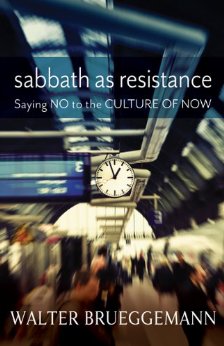
Book Review: Sabbath as Resistance

by Walter Brueggemann.

Brueggemann uses the Sabbath as a prism through which we understand economics and social relations and the ideological assumptions embedded in each.


“The demands of market ideology pertain as much to consumption as they do to production” (Brueggemann xii).  It is “Pharaoh’s insatiable script.”    

“Wherever YHWH governs as an alternative to Pharaoh, there the restfulness of YHWH effectively counters the restless anxiety of Pharaoh” (xiii).

Sabbath and the First Commandment

God is embedded in a narrative and cannot be known outside that narrative (2).  The Sabbath commandment is drawn into the Exodus, whose narrative matrix is that of YHWH.  

The economics of Pharaoh:
  • every socioeconomic system will be legitimized by some god (3).
  • The system is designed to create endless surplus, and thus endless storerooms.  
  • it makes a fetish of the market.  The market generates a desire for commodities of a social value, making us want even more commodities, which takes on a life of its own.
  • It creates anxiety.
  • Pharaoh is anxious about the food monopoly (26).  
  • It is an ontology of violence (30-31).

The Sabbath is a commitment to covenant (relationship) rather than commodity (bricks).  Most of the ten commandments have something to do with the horizontal “Other,” my neighbor.  The economics of Pharaoh does not allow for neighborliness.  The economics of the Sabbath demands it.

Thesis:  “Sabbath is a bodily act of testimony to alternative and resistance to pervading values and assumptions behind those values” (21).

Resistance to Anxiety

Anxiety makes neighborliness impossible (26).  God counters anxiety with neighborliness.

Resistance to Coercion

The prosperity of the land will eventually lead to two economic systems: possession or inheritance (38).

The aim of market ideology is to make us forget our rootage and to let ourselves be defined by alien expectations (39). The Sabbath makes us remember that God broke the cycle of coercive production.

Resistance to Exclusivism

Whom does Brueggemann think are the “Insiders?”  Brueggemann suggests that Isaiah 56 reworks Dt 23 so that Sabbath is the criterion of membership (54).  A Sabbath person is defined by justice, mercy, and compassion, and not competition, achievement, and production.

Sabbath and the Tenth Commandment

The 10th commandment rejects an attitude of “and a forced action to secure what is craved” (71).  Given that the term “neighbor” occurs 3x in the commandment, it is also about preserving the neighborhood.  

Brueggemann speculates, albeit with some justification, that these were agrarian peasants and the commandment ultimately applied to protecting them against urban elites, which in today’s terms meant:
  • state power
  • corporate wealth
  • legal sharpness
  • credentialed religion

In conclusion, the tenth commandment, and Sabbath-practice in general, is a safeguard for a certain way of organizing social power in the interest of the neighborhood (77).

Wednesday, July 29, 2015

Os Guinness--Power Apologetics?

He notes,

Part of the church, particularly the charismatic or Pentecostal streams, sees signs and wonders as key to apologetics. Signs contradict naturalism, and raise up hopes and dreams of greater things. What do you think of that?
 I believe passionately in it. As Peter Berger says, we live in a world without windows. We need to go back to the New Testament. Our Lord is the Father’s greatest gift, and the Holy Spirit is Jesus’s greatest gift to us. You can see apologetics accompanying deliverance and healings right down to the fifth century. Augustine started a little skeptical, and then became a passionate believer through experience. He records more than 70 miracles in Hippo.
And then sadly, in the centuries that followed, signs were specialized to certain people (the saints) and certain places (the healing centers). Then it was surrounded with superstition and moneymaking. The Reformation came along and, in throwing out all the corruptions, tended to throw out the baby with the bathwater. It stressed the Word and not the Spirit. Then came the Enlightenment. Many of the more sophisticated people in the church today frankly are operational atheists, and don’t have a living sense of the Holy Spirit. Reviving that sense is absolutely a key part of apologetics.

Miracles as Jesus's Donum to the Church

Musings from Milbank's (in)famous essay, "Alternative Protestantism."

Premise: The gift of Christ is the gift of the Spirit to the Church (38).  It is a gift that is beyond law.  It is a divine indwelling power.

Premise 2: What about the Spirit as donum is withdrawn from the church?  In other words, do we have the full Spirit/donum today?  You have to answer yes.  Should we then expect the full donum?  Certainly, why not?  Ergo, cessationism is false.

If aspects of the Spirit-donum have been withdrawn, we need evidence that it has.   Was Jesus crossing his fingers when he promised us his donum?